
Noise Does Not Move People. This Does.
The Loudest Voice in the Room Is Not Always the One People Hear
On reach, resonance, and what it actually takes to move people — in a room or in a business.
Something unexpected happened month after a speaker event.
The impact leaderboard, ranked by engagement score (views + likes × 10) showed the results. Names most people in business would recognise immediately: bestselling authors, Hall of Fame speakers, marketers with audiences in the millions. And there, at number 19, was me.
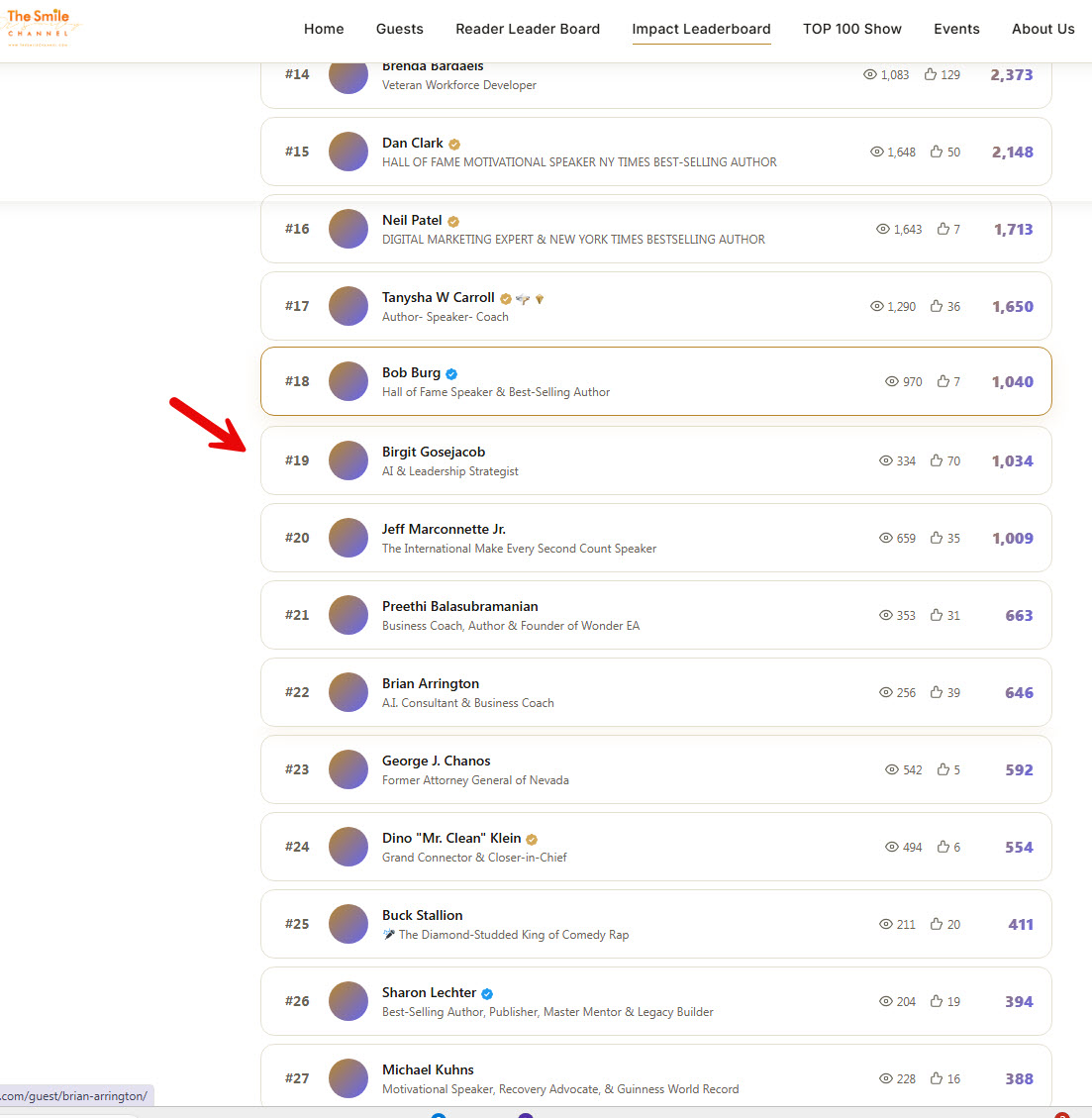
(click here for the most current live status: https://thesmilechannel.com/leaderboard/)
Why did I land there? Not because I had the most views. I didn't. Others had five, ten times the reach.
But the engagement score - the number of people who actually stopped, responded, reacted - told a different story. A smaller audience. A much higher response.
I sat with that for a while, because it felt like it was saying something important. Not about me. About what actually moves people.
When reach becomes noise
We live in a moment of extraordinary volume.
In business, that volume has a name right now: AI.
Every week brings a new tool, a new capability, a new headline. Organizations are under pressure to adopt, to automate, to transform. And many are responding the way you respond to pressure, by reaching for the most visible thing in front of them.
The shiniest tool.
The biggest promise.
The fastest implementation.
The result is activity. Lots of it. And often — very little movement.
Because reach without resonance is just noise. And noise, no matter how loud, does not change behavior. It does not shift a culture. It does not make a team trust a new direction.
The organizations genuinely moving the needle with AI are the ones who started with a question rather than a solution. Who defined, precisely and honestly, what problem they were trying to solve before they opened a single browser tab. Who chose one small, contained pilot and let it prove something real before scaling anything.
Intent first. Evidence next. Scale after.
That is not a slower path. It is the only path that actually leads somewhere worth going to.
The team member nobody introduced
Here is a way of thinking about AI adoption that I keep coming back to.
When a new person joins a team, the leader does not simply hand them a laptop and point them at the work. Not if they want things to go well.
They think about how this person fits.
They ask the existing team what they need, where the friction is, what would actually make their work better.
They pay attention to the dynamics.
Bringing AI into a business is not different. Not really.
AI is, in many ways, a new team member.
One with unusual capabilities and significant limitations. One who needs context, clear direction, and a manager who has done the work of understanding what the team actually needs before making the introduction.
Too many organizations skip that step. They bring in the new colleague, announce the change, and wonder why the team is resistant.
The resistance is not irrational. It is information.
What your people already know
When leaders slow down long enough to ask their teams about AI, genuinely ask, not perform the consultation, two things emerge almost immediately.
Fears. And ideas.
The fears are real, and they deserve to be heard without dismissal.
Will the AI replace me?
Will I become irrelevant?
Am I being managed out through a software update?
These are not small questions. They are the questions that will determine whether your AI implementation builds momentum or quietly stalls.
The ideas are just as real and often more valuable than anything a consultant brings in from the outside. The person who has done the same task ten thousand times knows exactly where the friction is. Your people know what takes too long, what gets done twice, what falls through the gaps. They know where AI could genuinely help — if anyone thought to ask.
Both the fears and the ideas are data. Leadership is knowing how to hold both.
The leader who creates space for that conversation, who acknowledges the fear without amplifying it, and channels the ideas into something actionable, is the leader who will actually bring their people through this transition rather than leaving half of them behind.
There is no one-size-fits-all
One of the most quietly damaging ideas in the current AI conversation is that there is a standard playbook: That what worked at one company, in one sector, with one team, is transferable as-is to yours.
It is not.
Because the variable that matters most is not the technology. It is the people.
Their history with change.
Their relationship with leadership.
Their handling of uncertainty.
Their specific knowledge of the work.
Those things are different in every organization. Which means the application of AI has to be different, too.
This is not a reason to delay. It is a reason to be precise. To ask better questions before choosing tools. To pilot in the place where the answer will be clearest, not the place that looks most impressive in a board presentation.
Small, intentional, human. That is how momentum actually builds.
Back to the Impact Leaderboard
The engagement that showed up on that leaderboard was not the result of a strategy. It was the result of showing up as myself, with the things I actually believe, the questions I genuinely think leaders need to sit with, and a willingness to say the uncomfortable thing rather than the reassuring one.
That, I think, is the throughline.
Whether you are a speaker trying to connect with a room, or a leader trying to bring a team through an AI transition, the mechanism is the same. Authenticity is not a soft idea. It is a measurable one. People respond to what is real. They disengage from what is performed.
The loudest voice in the room is not always the one people hear.
The one they hear is the one that says something true.
If you are curious about my contribution to the International Smile-A-Thon 2025, you can
And yes - if you watch and leave a like, it counts toward the impact leaderboard. Every response does. Which is exactly the point.