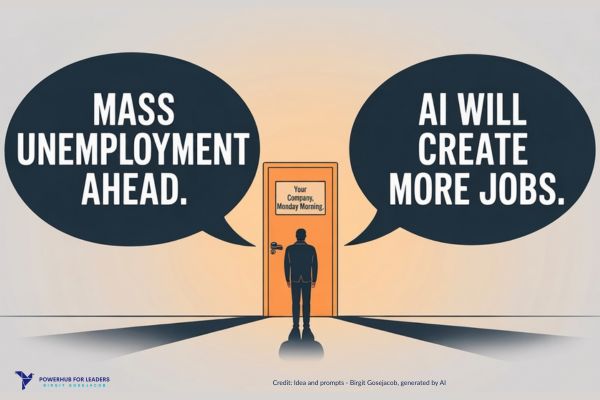
The AI Jobs Debate Has Two Sides. You're Not on Either of Them.
Jensen Is Right. So Is Dario. Here's the Problem.
Both men are worth listening to. Jensen Huang built Nvidia into one of the most valuable companies on earth by betting on human-machine collaboration before most people were taking it seriously.
Dario Amodei watched AI agents match and outperform his own staff and had the intellectual honesty to say so publicly. When either of them speaks about where AI is headed, it's worth your attention.
Here's the thing: they're both telling the truth.
Huang says you won't lose your job to AI - you'll lose it to a colleague who uses AI better than you do. He describes a future where AI agents harass and micromanage workers in the most productive possible sense, driving pace and scale that humans couldn't sustain alone. His prediction is more jobs, not fewer. The tool doesn't replace the person. The person who uses the tool replaces the person who doesn't.
Amodei says up to 50% of entry-level white-collar jobs could disappear within five years. He names specific fields - finance, consulting, law, tech - and estimates unemployment could hit 10 to 20%. He says most people aren't ready for it. He says most people don't even believe it yet. And he says the disruption won't be sequential, moving through one industry at a time. It will be simultaneous, hitting knowledge work broadly and leaving fewer places for displaced workers to land.
Both positions are defensible.
Both are backed by real evidence.
And for the CEO running a 60-person company, neither one actually helps.
The problem with the current conversation
The AI-and-work debate is happening at a scale that has nothing to do with how most businesses operate. It's the scale of $135 billion capital expenditure budgets. The scale of cutting 8,000 jobs and absorbing the impact inside a 70,000-person organization. The scale of entire sector disruptions tracked by Stanford's AI Index and the Federal Reserve Bank of New York.
That is not your scale.
You have real people. Specific people, with names, tenure, mortgages, and skill sets you've developed together over years. You don't have a dedicated AI team standing by to redeploy your workforce. You don't have the headcount slack that makes a 10% reduction an operational adjustment rather than an organizational wound. And you don't have two years of runway to be wrong about this before correcting course.
The executives at Meta and Microsoft who are cutting thousands of jobs are not making reckless decisions. Many of them are making entirely rational calls based on the evidence in front of them. But they are operating at a scale where those decisions are even possible. An 8,000-person reduction at Meta is a 10% trim. The proportional equivalent at your company means gutting the people who built what you have.
There's also a phenomenon worth naming that adds noise to the signal: AI washing (more on this: AI-Washing: What the Block Layoffs Actually Tell Us — context on the layoff narrative and AI washing)
Some companies are attributing layoffs to AI efficiency that are actually the result of over-hiring during the post-pandemic growth period, a cooling market, or straightforward cost management. Deutsche Bank analysts warned in 2026 that AI-washing would be a significant feature of the year - companies using AI as cover for cuts that have other causes entirely.
As a leader trying to read the macro environment, the headline number on AI-driven layoffs is almost certainly overstated. That doesn't mean the underlying trend isn't real. It means you need to look past the press releases to the actual capability shifts, which are real and accelerating, rather than the headcount announcements, which are messier.
What this actually means at your scale
The timeline Amodei describes is real. A window of one to five years is not distant. The capabilities he's referencing are already demonstrable today, not theoretical. If you have roles in your organization that involve substantial document review, data analysis, research synthesis, or routine client communication, the tools that can assist or replace parts of those tasks exist right now.
They are imperfect and they require skilled human judgment to use well - but they are here, and they are improving faster than any previous technology wave.
The opportunity Huang describes is also real. The companies that come out of this period strongest will be the ones that used the transition window to build genuine AI capability into their teams - not by buying software and hoping for the best, but by developing people who know how to think alongside it.
The difference between an organization that dabbles and one that genuinely integrates is already measurable in productivity, in talent retention, and in the quality of strategic output.
But here's what neither Huang nor Amodei addresses in their predictions: the messy, human, operational middle where actual companies run.
You can't simply announce that AI is coming and wait to see what happens.
You can't send everyone to a two-day workshop and call it transformation.
You can't buy the enterprise license for a platform nobody uses.
And you can't pretend the headlines don't apply because your company is too small to matter to the analysts tracking macro trends.
You matter to the people who work for you. And the decisions you make in the next 18 months will determine what they're working in five years from now.
The three questions that actually matter for you
When I work with leaders navigating this, I push past the macro noise and into three questions that neither Huang nor Amodei is asking.
The first is: who on your team is genuinely ready to grow into this, and who needs something different from you right now? This is not a question about technical aptitude. It's a question about psychological readiness - about who can tolerate the ambiguity of a tool that changes constantly, iterate without ego investment in any particular output, and stay curious when the learning curve feels steep. Those qualities don't correlate neatly with job title or years of experience. Your most AI-ready person might be your operations coordinator, not your head of strategy. Until you look at the actual people rather than the org chart, you don't know.
The second is: what is AI realistically capable of changing in your operation over the next 12 months, and what does that mean for how you lead the people in those roles? This requires honest assessment rather than either panic or dismissal. Which tasks are genuinely candidates for AI assistance? Which require the kind of contextual human judgment that the tools can't replicate yet? And for the people whose roles will shift - what does that conversation look like, and when do you have it? The leaders who will do this well are the ones who have that conversation before it's forced on them by circumstances.
The third is: what kind of leader do you need to be during this period - not in the abstract, but in the room, in the actual conversations, with your actual team? This is the question most leadership content about AI entirely skips. Your team is watching you. How you talk about AI, whether you use it yourself, how you respond when someone struggles with it, whether you create space for honest conversation about what people are worried about - all of that is leadership data your team is collecting continuously. You don't get to be neutral on this. The way you show up shapes the culture that makes adoption possible or turns it into performance.
The middle is not comfortable. It's necessary.
The noise from both ends of the AI debate is, in a strange way, easier to live in than the middle. If you believe Amodei fully, you can catastrophize and freeze. If you believe Huang fully, you can stay optimistic and delay. Both postures have the advantage of not requiring you to act right now.
The middle requires something harder: making real decisions with incomplete information, moving forward without certainty, and leading people through a transition whose destination you can't fully describe yet. That's not comfortable. It's also not optional.
Jensen and Dario are both right. The question is what you're going to do with that - at your scale, with your people, this year.
A question leaders often ask about this topic:
AI disruption predictions focus on Fortune 500 scale - mass layoffs, billion-dollar budgets, sector-wide unemployment projections. For SMB CEOs running 20 to 200-person organizations, the relevant question is different: who on my team is ready to grow with AI, what will it change in my operation in the next 12 months, and what kind of leadership does this moment require from me? The macro debate between optimists and pessimists is less useful than three precise questions about your specific people, your specific operation, and the leadership posture you need to hold right now
If you're ready to move from the headlines into a practical plan for your organization, start with an AI Clarity Call. 30 minutes, your situation, your team - get clarity on how AI can help you and your team.
If you want to bring this conversation to your leadership audience, book a speaking contribution. This is exactly the kind of room it's built for.