What AI Actually Looks Like in Practice - Five Real Cases Every CEO Should Know
Most of what you read about AI in business falls into one of two camps: breathless hype or cautionary doom. Neither helps you make a decision.
So here are five real cases - published, sourced, verifiable - that show what AI actually delivers when it's deployed thoughtfully. And in one case, what happens when it isn't.
Read these not as technology stories. Read them as leadership stories.
1. Klarna: The Case That Taught Everyone a Lesson, Including Klarna
In February 2024, Swedish fintech Klarna launched an OpenAI-powered customer service assistant. The initial numbers were extraordinary.
Within its first month, the assistant handled 2.3 million conversations, roughly two-thirds of all customer service chats.
Resolution time dropped from 11 minutes to under 2 minutes.
Repeat inquiries fell by 25%. Customer satisfaction held steady, on par with human agents.
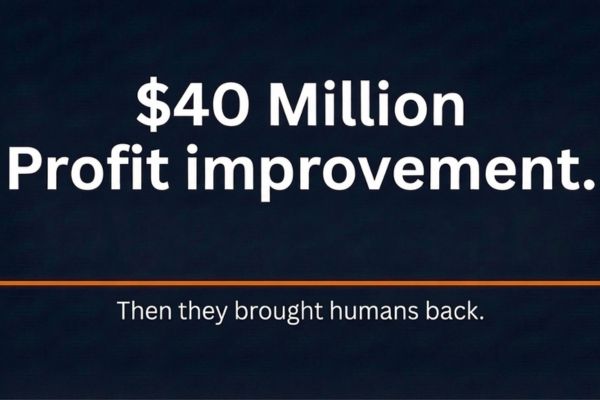
Klarna projected a $40 million profit improvement for 2024.
(Source: Klarna press release, February 2024; OpenAI case study)
The world took note. This looked like proof that AI could replace human service teams entirely.
Then came Act Two.
By 2025, Klarna's CEO Sebastian Siemiatkowski publicly acknowledged that cost had become "a predominant evaluation factor" in their support strategy, and that
quality had suffered.
Customers were frustrated.
Klarna began rehiring human agents.
The company is now building what it calls a hybrid model: AI handles routine volume, humans step in when nuance is needed.
(Source: Bloomberg, eMarketer, 2025 reporting on Klarna's reversal)
What this means for you: The speed gains were real. The savings were real. But the lesson is also real: AI that eliminates human judgment rather than supporting it creates a gap your customers will find. The winning model isn't AI instead of people.
It's AI deployed strategically so your people can focus where they matter most.
2. Siemens: When the Machine Predicts the Problem Before It Happens
Siemens implemented AI-driven predictive maintenance across its manufacturing plants. By installing sensors on critical machinery and running machine learning models against the data, the system could identify likely equipment failures before they occurred.
The result:
a 25% reduction in unexpected power outages
and an estimated $750 million per year in cost savings from avoided production interruptions, scrap, and emergency repairs.
(Source: Siemens, widely reported — including growthjockey.com and typewiser.com compilations of published data)
This is operations intelligence at scale. Not science fiction. Not a pilot. A deployed system delivering measurable results.
What this means for you: You don't need to be Siemens to apply this logic. Any operation with recurring equipment, recurring failures, or recurring bottlenecks has a predictive AI use case waiting to be found. The question isn't whether the technology exists.
The question is: what's your most expensive recurring problem?
3. BCI: 2,300 Hours Back, for What Matters
British Columbia Investment Management Corporation (BCI) deployed Microsoft 365 Copilot across its workforce. The results were tracked and published by Microsoft.
Productivity improved by 10–20% for 84% of Copilot users.
Job satisfaction increased by 68%.
The organization saved more than 2,300 person-hours through automation, reduced time spent writing internal audit reports by 30%, and cut a month of processing time in analyzing 8,000 survey comments.
(Source: Microsoft Cloud Blog, published January 2026)
What stands out here isn't just the efficiency. It's the satisfaction number. When people stop spending their days on work that a machine can do better, they feel better about their work. That's not a soft metric. That's a retention and performance signal.
What this means for you: The ROI argument for AI rarely factors in the human cost of administrative overload. Your best people are probably doing too much robot work. Every hour they spend on tasks AI could handle is an hour they're not spending on the thinking, relationships, and judgment that actually move your business.
4. Telenor: 20% Higher Customer Satisfaction - and Revenue to Match
Telenor, a global telecom operator, introduced an AI chatbot named "Telmi" to handle routine customer inquiries across multiple languages, around the clock.
The outcome:
customer satisfaction improved by 20%
and annual revenue increased by 15% following the rollout.
By efficiently resolving common questions and freeing human agents for complex cases, Telenor reduced operational costs while simultaneously improving the experience that drives loyalty and purchase behavior.
(Source: typewiser.com analysis of published Telenor data, 2025)
This is the double effect that AI makes possible when it's deployed correctly: lower costs on one side, higher revenue on the other - because a better experience creates customers who stay and buy more.
What this means for you: If your customer-facing team is currently bottlenecked by volume such as handling routine queries, repeating the same answers, managing the same requests, it's not a staffing problem anymore.
That's an AI opportunity.
5. JPMorgan's Wealth Division: 20% More Sales, Not Despite AI, but Because of It
JPMorgan's Asset and Wealth Management division deployed an AI tool called Coach AI to support financial advisors with research, client data, and preparation. The system tracks client investment priorities, surfaces relevant data in real time, and handles the analytical groundwork that previously consumed hours of advisor time.
Between 2023 and 2024, the division saw a 20% increase in gross sales. JPMorgan expects its advisors to grow their client base by 50% over the next three to five years — not by hiring proportionally more advisors, but by freeing each advisor to serve more clients well.
(Source: Persana AI analysis of JPMorgan published data, 2025)
This is the model most leaders haven't yet internalized: AI doesn't replace the relationship. Instead, it frees the human to be fully present in it.
The advisor is still the advisor.
AI handles the research.
The conversation stays human.
What this means for you: Whatever your equivalent of "hours analyzing market data before a client call" looks like, that's where AI belongs. Not in the relationship. In the preparation for it.
What These Five Cases Have in Common
They didn't start with AI strategy.
They started with a business problem.
Klarna: customer service volume.
Siemens: production downtime.
BCI: administrative overload.
Telenor: support bottleneck.
JPMorgan: advisor capacity.
The technology is different in every case. The logic is identical: find the painful, repetitive, time-consuming problem, and build the AI use case around that.
What's also consistent: none of these implementations were simply switched on and forgotten. The successful ones involve human oversight, iteration, and a clear understanding of where AI ends and human judgment begins. Klarna learned this the hard way.
Success comes with the answer to why they're automating, and what they want their people to do with the time that gets freed up.
That's not a technology question. That's a leadership question.
If you're looking for where to get AI into your own business, the first question isn't "which AI tool should we use?" It's "what's our most painful operational bottleneck right now?"
The answer to that question will tell you everything you need to know about where AI belongs in your organization.
.
Sources:
- Klarna AI assistant press release, February 2024: klarna.com/international/press/klarna-ai-assistant-handles-two-thirds-of-customer-service-chats-in-its-first-month/
- Klarna hybrid model reporting: Bloomberg / eMarketer 2025
- Siemens predictive maintenance: widely reported, including growthjockey.com and typewiser.com
- BCI / Microsoft Copilot results: Microsoft Cloud Blog, January 2026 (blogs.microsoft.com)
- Telenor Telmi results: typewiser.com case study compilation, May 2025
- JPMorgan Coach AI: Persana AI analysis of published JPMorgan data, 2025